Author: Expert Team (Technology and Legal Departments), Bio Light
The label is the first thing a consumer sees and the first thing an inspector checks. Since 2025–2026, the labeling requirements for dietary supplements in Ukraine have become significantly stricter: new mandatory elements have been added, penalties have increased, and the AMCU is actively imposing fines for any wording that implies medicinal properties.
In this article, we have collected everything a manufacturer or contract production client needs to know about proper labeling — without legal jargon and with specific examples.
Regulatory Acts Governing Dietary Supplement Labeling
Dietary supplement labeling in Ukraine is not regulated by a single document — the requirements are spread across several laws and orders of different levels. Below is a structured list: first, the core acts without which it is impossible to prepare a label, and then the additional ones that should be taken into account in specific situations.
Core Regulatory Acts (Mandatory for Every Label)
1. Ministry of Health of Ukraine Order No. 1114 dated December 19, 2013 — “On Approval of Hygienic Requirements for Dietary Supplements” (registered with the Ministry of Justice on December 27, 2013 under No. 2231/24763).
This is the main sector-specific document for dietary supplements. Section III (clauses 3.1–3.4) contains a specific list of mandatory label statements, three mandatory warnings, and prohibitions regarding medicinal claims. Annexes 1–2 define permitted vitamins, minerals, and their forms. Section II (clause 2.5) sets dosage requirements. Amendments to this order are currently under consideration; they will introduce a clear dosage verification hierarchy (EFSA UL → Safe Level → national tables) and an expanded list of permitted substances (Annex 3 — plants, amino acids, microorganisms).
2. Law of Ukraine No. 2639-VIII dated December 6, 2018 — “On Information for Consumers Regarding Food Products.”
This is the basic law for labeling all food products, including dietary supplements. It defines:
— Art. 6: the list of mandatory information (name, composition, market operator with EDRPOU code, expiry date, storage conditions, country of origin, etc.);
— Art. 10: language requirements (all mandatory information must be in Ukrainian);
— Art. 12: the order of listing ingredients (in descending order by weight);
— Art. 15: rules for highlighting allergens;
— font size requirements: the minimum x-height is 1.2 mm, and 0.9 mm for packages with an area under 80 cm².
Penalties: inaccurate information — 15 minimum wages (~UAH 129,705), allergen-related violations — 30 minimum wages (~UAH 259,410).
Note: The law has several versions entering into force on different dates, including the next version on September 16, 2026. We recommend monitoring amendments.
3. Law of Ukraine No. 4122-IX dated December 5, 2024 — “On Amendments to Certain Laws of Ukraine Regarding the Improvement of Regulation of the Production and Circulation of Dietary Supplements.”
It entered into force on March 26, 2025, and was put into effect on September 27, 2025. In terms of labeling, it establishes a key requirement: product labeling must match the information submitted to the State Service of Ukraine on Food Safety and Consumer Protection in the notification. Any discrepancy between the label and the notification results in a fine of UAH 640,000 for legal entities and UAH 600,000 for sole proprietors.
It also grants the Ministry of Health the authority to approve lists of permitted substances and maximum allowable doses.
4. Law of Ukraine No. 771/97-VR dated December 23, 1997 — “On Basic Principles and Requirements for Safety and Quality of Food Products” (as amended as of September 27, 2025, taking into account changes introduced by Law No. 4122-IX).
This is the framework law for all food products. It contains the updated definition of a dietary supplement (Art. 1), the obligations of market operators (Art. 20), traceability and batch number requirements (Art. 22), and general labeling requirements (Art. 39). It is the “parent” law amended by Law No. 4122-IX.
Additional Acts to Consider
5. Law of Ukraine No. 270/96-VR “On Advertising.”
This applies not only to advertising but also to labeling. It prohibits attributing medicinal properties to dietary supplements. After the amendments introduced by Law No. 4122-IX, the wording was clarified: it is prohibited to refer to medicinal properties in advertising for dietary supplements, food for special medical purposes, and weight control products. The AMCU applies this law together with the Law “On Protection Against Unfair Competition” — it was on this basis that fines totaling tens of millions of hryvnias were imposed in 2024–2025.
6. Law of Ukraine No. 236/96-VR “On Protection Against Unfair Competition.”
Art. 15-1 concerns the dissemination of false information about product properties. The AMCU actively uses this article to fine manufacturers for medicinal claims on dietary supplement packaging and in advertising. Fines under this article have no fixed upper limit and are calculated individually — 2025 practice shows amounts ranging from UAH 250,000 to over UAH 38 million in a single case.
7. Order of the Ministry of Economic Development No. 914 dated August 4, 2015 — “On Approval of Definitions of Basic SI Units… and Rules for the Use of Units of Measurement.”
This defines the rules for writing measurement units on labels. According to this order, SI unit symbols must be indicated in Latin script (mg, μg, g). At the same time, Law No. 2639-VIII requires information to be in Ukrainian. This creates a practical recommendation: use a combined format — “мг(mg)”, “мкг(μg)” — to satisfy both requirements.
8. Order of the Ministry of Agrarian Policy No. 244 — procedure for sending a notification of the intention of first placing a product on the market.
It does not directly relate to the text of the label, but it defines the notification form in which the product name is specified and to which a sample label is attached. After notification, the labeling becomes legally fixed — any change requires re-notification.
9. Ministry of Health Order No. 45 dated January 8, 2024 — “Requirements for Food Additives.”
If a dietary supplement contains food additives such as colorants, preservatives, or sweeteners, their labeling must comply with this order. In particular, it establishes special requirements for tabletop sweeteners and allergen warnings.
10. Cabinet of Ministers Resolution No. 186 dated March 3, 2022 — “Certain Issues of Food Product Labeling Under Martial Law.”
This temporarily simplifies labeling requirements by allowing products to be sold with information in a language other than the state language. It applies during martial law. However, for dietary supplements subject to notification, the sample label must be submitted in the state language, so in practice Ukrainian labeling remains mandatory.
11. EU Directive 2002/46/EC — “On the Approximation of the Laws of the Member States Relating to Food Supplements.”
It is not directly binding in Ukraine, but it is important for two reasons: Law No. 4122-IX was harmonized with this directive in terms of definitions, labeling approaches, and dosage principles; and if the product is also sold in the EU, the labeling must comply with both Ukrainian and European requirements.
12. EU Regulation No. 1169/2011 — “On the Provision of Food Information to Consumers.”
Similarly, it is not part of Ukrainian legislation, but Law No. 2639-VIII is based on this regulation. It is useful as a reference for understanding the logic behind font size requirements, allergen highlighting, and labeling structure.
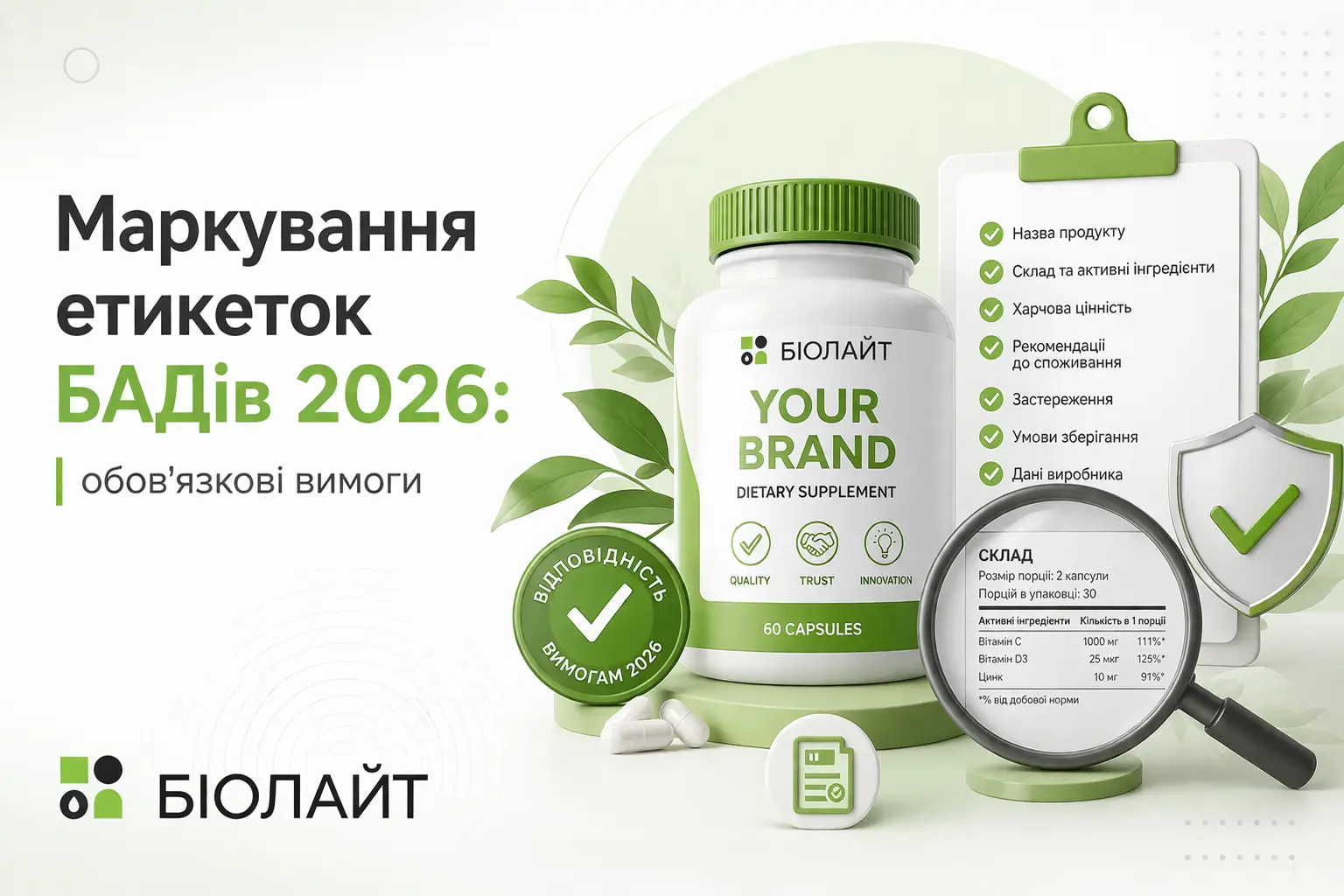
Mandatory Label Elements
Below is the full list of what must appear on every dietary supplement label. The absence of any of these elements may result in a fine.
1. The wording “DIETARY SUPPLEMENT”
This is the first and critically important element. According to clause 3.1 of Ministry of Health Order No. 1114, the label must indicate that the product is a dietary supplement. This wording must be clearly visible — not in tiny print in a corner, but clear and easy to understand.
2. Product name
The commercial product name in accordance with Art. 6 of Law No. 2639-VIII. Important: after Law No. 4122-IX entered into force, the name on the label must exactly match the name stated in the notification submitted to the State Service on Food Safety and Consumer Protection.
3. Full composition with the amount of each ingredient
A list of ingredients with the quantity of each. Ingredients must be listed in descending order by weight (Art. 12 of Law No. 2639-VIII). Active substances must include the exact dosage per unit of product such as tablet, capsule, or serving. Excipients must be listed separately.
4. Recommended daily dose
According to clause 3.1 of Ministry of Health Order No. 1114, the recommended amount or serving of the dietary supplement for daily consumption must be indicated. For example: “Adults: 1 capsule daily with meals.”
5. Three mandatory warnings
Ministry of Health Order No. 1114 (clause 3.1) requires three statements that must appear on every label without exception:
“Do not exceed the recommended daily dose for consumption” — this wording is established by law. It is not recommended to shorten or paraphrase it.
“Dietary supplements should not be used as a substitute for a complete diet” — this informs the consumer that the supplement complements, not replaces, normal nutrition.
“Keep out of reach of children” — a mandatory safety statement.
These three phrases are not recommendations but legal requirements. The absence of any of them is grounds for a fine.
6. Market operator information
According to Law No. 2639-VIII (Art. 6), the label must state:
The full name of the legal entity or sole proprietor.
The EDRPOU code for legal entities or TIN for sole proprietors. The absence of the EDRPOU code is one of the most common critical mistakes. The fine is up to UAH 640,000.
The legal address of the market operator.
7. Manufacturer information
If the manufacturer and the market operator are different entities, for example in contract manufacturing, the label must state the manufacturer’s name and address.
8. Expiry date and storage conditions
Expiry date: indicated in the format “Use by: DD.MM.YYYY” or “Shelf life: N years from the date of manufacture.”
Storage conditions: temperature range, humidity, protection from light. For example: “Store in a dry place protected from light at a temperature from +5°C to +25°C and relative humidity not exceeding 75%.”
9. Batch number
According to Art. 22 of the Law “On Basic Principles and Requirements for Safety and Quality of Food Products” (No. 771/97-VR), batch information is mandatory to ensure product traceability.
10. Allergens
According to Art. 15 of Law No. 2639-VIII, allergens must be clearly highlighted within the composition using a font that differs from the main text, for example bold type or capital letters. The fine for incorrect allergen indication is up to UAH 259,410 for legal entities, equal to 30 minimum wages in 2026.
11. Net quantity of the product
The number of units in the package and the mass of the contents of one unit. For example: “60 capsules. Content mass of 1 capsule: 500 mg ±7.5%.”
Prohibited Wording: What Must Not Be Written
This is one of the riskiest areas. Ministry of Health Order No. 1114 (clauses 3.2–3.4) and the Law “On Advertising” (No. 270/96-VR) establish clear prohibitions. AMCU practice in 2024–2025 shows that violations of these prohibitions can lead to fines in the tens of millions.
Absolutely prohibited
Medicinal claims in any form: “treats,” “heals,” “prevents diseases,” “for treatment.”
Names of specific diseases: “for hypertension,” “for arthritis prevention,” “helps with depression.”
Medical terminology: “diagnosis,” “therapy,” “therapeutic effect,” “clinically proven to treat.”
Positioning as a medicinal product: “replaces medicine,” “better than antibiotics,” “natural analogue of [drug name].”
Claims of “fast action” or “instant effect” — the AMCU classifies these as medicinal claims.
Grey area — best avoided
“This product is not intended to diagnose, treat, or prevent any disease” — this is a common phrase copied from the U.S. market as an FDA disclaimer. In Ukraine, it is problematic: although it formally denies medicinal properties, it still mentions medical terms such as “diagnose,” “treat,” and “prevent.” Recommendation: do not use it.
Correct wording
Instead of lengthy disclaimers, a short phrase is sufficient:
“Not a medicinal product”
This wording is an established market practice in Ukraine and does not contain prohibited terms.
What is allowed
General functional claims are allowed provided that they are not misleading and do not mention specific diseases:
“Supports the normal functioning of the immune system” — acceptable.
“Treats flu” — prohibited.
“Contains zinc, which helps maintain normal skin condition” — acceptable.
“Eliminates acne and dermatitis” — prohibited.
Important: any functional claims must be scientifically substantiated and comply with health claim requirements.
Labeling Language and Units of Measurement
Language — Ukrainian only
According to Art. 10 of Law No. 2639-VIII, all mandatory information on the label must be in the state language. This applies not only to the main text but also to warnings, composition information, and storage conditions.
Exceptions: the trademark and the address of a foreign manufacturer, except for the country name, may be stated in the original language.
Units of measurement — combined format
The safest option is to indicate measurement units in Ukrainian with SI symbols in parentheses:
Correct: “25 мг(mg)”, “300 мкг(μg)”
Risky: “25 mg” only in Latin script without Ukrainian spelling
Although the international SI system is permitted, Law No. 2639-VIII requires information in Ukrainian. The combined format is a safe compromise that satisfies both requirements.
Font Size Requirements
Law No. 2639-VIII sets the minimum x-height at 1.2 mm. For packages smaller than 80 cm², 0.9 mm is allowed.
In addition to size, the text must be:
Legible and clear.
Contrasting with the background, for example dark text on a light background.
Placed in a visible location — not on a fold and not under a flap.
Durable enough not to rub off during the entire shelf life.
Example of a Properly Formatted Label
Below is a sample label text structure that complies with all legal requirements:
DIETARY SUPPLEMENT [PRODUCT NAME] [Quantity] [dosage form]
Composition per 1 [unit]: [ingredient 1] — [amount] mg, [ingredient 2] — [amount] μg. Excipients: [list]. Content mass of 1 [unit]: [mass] mg ±7.5%.
Daily dose recommended for consumption: adults — [quantity] [units] per day [method of use].
Do not exceed the recommended daily dose for consumption. Dietary supplements should not be used as a substitute for a complete diet.
Warnings: [list]. Consultation with a doctor is recommended before use. Not a medicinal product.
Keep out of reach of children. Storage conditions: [details].
TU U [number]
Responsible person / Market operator: [Name] EDRPOU code: [code] [Address]
Manufacturer: [Name and address]
Shelf life: [period] from the date of manufacture. Batch number: [number/date].
Common Mistakes We See in Practice
Working with dozens of clients, we at Bio Light often encounter the same labeling mistakes. Here are the most common ones:
Missing EDRPOU code. Surprisingly, this is mistake No. 1. Many labels include the company name and address but omit the EDRPOU code. The fine is up to UAH 640,000.
Using the U.S. market disclaimer instead of “Not a medicinal product.” As noted above, a lengthy disclaimer with medical terms can create more problems than it solves.
Units of measurement only in Latin script. “500 mg” instead of “500 мг(mg).” Formally, this violates language requirements.
Allergens not highlighted. Allergens are listed in the composition but do not visually differ from the rest of the text. The law requires visual emphasis.
Missing batch number. It is often forgotten or postponed “for later.” But without a batch number, the product does not meet traceability requirements.
Shortened mandatory phrases. “Do not exceed the dose” instead of the full wording. Or “Keep away from children” instead of “Keep out of reach of children.” We recommend using the exact wording from Ministry of Health Order No. 1114.
Turnkey Dietary Supplement Manufacturing by Bio Light LLC
Proper labeling is not just about formal compliance. It is the protection of your business from fines measured in hundreds of thousands of hryvnias and from reputational risks.
Bio Light LLC is a contract manufacturer of dietary supplements in Zaporizhzhia. We provide:
✓ Label text development in accordance with Law No. 4122-IX, Law No. 2639-VIII, and Ministry of Health Order No. 1114.
✓ Composition and dosage verification according to the EFSA hierarchy (Upper Limit → Safe Level → national tables).
✓ Audit of existing labels for compliance with new requirements.
✓ Assistance with preparing the notification document package.
✓ Manufacturing of finished products with compliant labeling.
Contact us: biolight.com.ua
This article was prepared by the Bio Light LLC team, Zaporizhzhia. The material is for informational purposes only and does not constitute legal advice. For final decisions, we recommend consulting a qualified specialist.
Key sources: Ministry of Health Order No. 1114 dated December 19, 2013 (clauses 3.1–3.4); Law of Ukraine No. 2639-VIII dated December 6, 2018 (Arts. 6, 10, 12, 15); Law of Ukraine No. 4122-IX dated December 5, 2024; Law of Ukraine No. 771/97-VR dated December 23, 1997 (Arts. 20, 22, 39); Law of Ukraine No. 270/96-VR “On Advertising”; Law of Ukraine No. 236/96-VR “On Protection Against Unfair Competition”; Order of the Ministry of Economic Development No. 914 dated August 4, 2015; Order of the Ministry of Agrarian Policy No. 244; Ministry of Health Order No. 45 dated January 8, 2024; Cabinet of Ministers Resolution No. 186 dated March 3, 2022; EU Directive 2002/46/EC; EU Regulation No. 1169/2011; AMCU decisions for 2024–2025.